
CBT for Anxiety Disorders: A Practical Guide for Patients and Families in Lahore
Anxiety can shrink a life quietly. However, CBT for anxiety disorders gives you a structured, proven way to reclaim it. At Harmony Mental Health Clinic and Rehabilitation Center, our clinicians use CBT for anxiety disorders to help patients replace fear with practical skills. In this guide, readers in the United States and Pakistan will learn the core techniques, a step-by-step treatment plan, and realistic expectations for recovery.
Clinical note: this article offers general education. It does not replace a professional diagnosis.
Table of Contents
- What Is CBT for Anxiety Disorders and How Does It Work?
- Signs You May Need CBT for Anxiety Disorders
- How CBT Therapy for Anxiety Changes Thoughts, Feelings, and Habits
- CBT for Anxiety Disorders: Core Techniques That Deliver Relief
- Building a CBT Treatment Plan for Anxiety That Fits You
- CBT for Health Anxiety: Breaking the Reassurance Cycle
- CBT for Death Anxiety: Facing Fear With Clarity
- CBT for Anxiety and Depression: Treating Both Together
- Which Conditions Respond to CBT for Anxiety Disorders?
- Why Choose Clinical CBT for Anxiety Disorders in Lahore
- What to Expect From CBT for Anxiety Disorders in Session One
- Daily Habits That Support Your Recovery
- Frequently Asked Questions About CBT for Anxiety Disorders
- Start CBT for Anxiety Disorders in Lahore Today
What Is CBT for Anxiety Disorders and How Does It Work?
Cognitive behavioral therapy is a structured, skills-based form of talk therapy. In simple terms, CBT for anxiety disorders teaches you to notice anxious thoughts, test them against evidence, and change the habits that keep fear alive. For a broader overview, you can read this summary of cognitive behavioral therapy on Wikipedia.
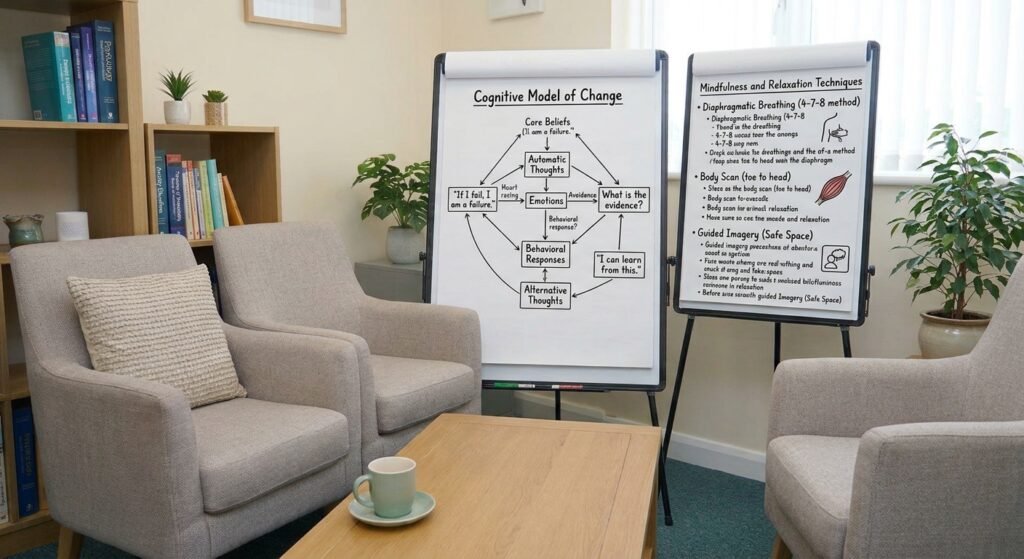
Moreover, therapists treat thoughts, body sensations, and actions as one connected loop. For example, a racing heart triggers the thought “something is wrong,” and then you avoid the situation. As a result, the fear grows stronger each time. CBT for anxiety disorders interrupts that loop at several points.
“What if I fail in front of everyone?”
Tight chest, racing heart, shaky hands, and shallow breathing.
Avoidance, escape, or repeated reassurance seeking.
Importantly, the therapy is collaborative. You and your therapist set goals together, and you practice new skills between sessions. Research consistently supports CBT for anxiety disorders as a first-line treatment for generalized anxiety, panic, and social anxiety. Therefore, many clinicians recommend it before medication or alongside it.
Signs You May Need CBT for Anxiety Disorders
Occasional worry is normal. However, persistent anxiety that disrupts work, sleep, or relationships deserves attention. Consider CBT for anxiety disorders if you notice several of these signs.
“What if” thoughts keep running, even when life goes well.
You skip events, calls, or travel to dodge discomfort.
Headaches, chest tightness, stomach upset, and poor sleep keep returning.
Sudden surges of fear arrive without a clear cause.
You check, search, or ask repeatedly for certainty.
Worry has drained your energy and your interest in daily life.
Furthermore, symptoms that last several weeks, or keep getting worse, signal that it is time to consult a professional. Early support shortens recovery. In addition, it stops avoidance from hardening into habit.
How CBT Therapy for Anxiety Changes Thoughts, Feelings, and Habits
First, CBT therapy for anxiety targets unhelpful thinking. Anxious minds often predict the worst, overestimate danger, and underestimate coping ability. Next, you learn to label these patterns, such as catastrophizing or mind reading, and you replace them with balanced thoughts.
Second, the therapy addresses the body. Because anxiety floods the system with adrenaline, you practice slow breathing, muscle relaxation, and grounding. Consequently, physical symptoms feel less frightening, and you recover faster after a spike.
Third, CBT therapy for anxiety changes behavior. Avoidance feels safe in the moment; however, it teaches the brain that the feared situation is truly dangerous. Therefore, your therapist guides you toward gradual, planned exposure. Over time, your brain learns a new lesson: you can handle this.
Finally, progress is measurable. Many clinicians use short symptom scales at the start and again during treatment. In addition, you track your own anxiety ratings in a simple diary. Together, these tools show improvement clearly and keep motivation high. In short, CBT for anxiety disorders works on all three levers at once.
CBT for Anxiety Disorders: Core Techniques That Deliver Relief
Strong CBT for anxiety disorders relies on practice outside the therapy room. These CBT techniques for anxiety work best when you repeat them daily. Meanwhile, your therapist blends several methods based on your symptoms and goals.
You write down an anxious thought, rate your belief in it, and examine the evidence. Then you craft a balanced alternative.
You build a fear ladder from mildly to highly distressing situations. Step by step, you face each rung until anxiety falls.
You test a feared prediction in real life. For example, you speak up in a meeting and then check what actually happens.
You set aside 15 minutes each day for worry. Outside that window, you gently postpone anxious thinking.
Slow diaphragmatic breathing and progressive muscle relaxation calm the body and lower baseline tension.
You observe thoughts without fighting them. As a result, worry loses its grip on your attention.
Notably, exposure is often the most powerful ingredient. Although it sounds daunting, your therapist controls the pace, and you never face a step without preparation. Likewise, every technique above becomes easier with repetition, so consistency matters more than intensity. That is why CBT for anxiety disorders includes short homework tasks after each session.
Building a CBT Treatment Plan for Anxiety That Fits You
A good CBT treatment plan for anxiety is individual, specific, and time-limited. Rather than offering generic advice, your therapist designs each phase around your triggers and goals. The table below shows a typical path.
| Phase | Main Focus | What You Do | Typical Timing |
|---|---|---|---|
| 1. Assessment | Understand symptoms, history, and triggers | Complete an interview and symptom scales | Sessions 1 to 2 |
| 2. Goals | Map your thought, feeling, and behavior loop | Set three to five measurable goals | Sessions 2 to 3 |
| 3. Skill Building | Learn restructuring, breathing, and grounding | Practice homework daily | Sessions 3 to 8 |
| 4. Exposure | Face feared situations gradually | Climb your fear ladder and run experiments | Sessions 6 to 16 |
| 5. Relapse Prevention | Lock in your gains | Write a personal maintenance plan | Final 2 to 3 sessions |
Importantly, timelines vary. Some people improve within eight sessions, while others need longer because of coexisting conditions. Therefore, your therapist reviews progress regularly and adjusts the plan. Furthermore, every plan for CBT for anxiety disorders ends with a written relapse prevention blueprint, so you keep practicing after therapy ends.
CBT for Health Anxiety: Breaking the Reassurance Cycle
CBT for health anxiety addresses a specific trap. A harmless sensation, such as a headache, triggers fear of serious illness. Then you search symptoms online, ask family for reassurance, or book repeated tests. Although these actions bring brief relief, they strengthen the worry in the long run.
Therefore, therapy focuses on the cycle rather than the symptom. First, you map how attention to your body amplifies sensations. Next, you reduce checking, online searching, and reassurance seeking step by step. Meanwhile, you test the belief “uncertainty is unsafe” through carefully planned experiments. As a result, your tolerance for uncertainty grows, and daily life opens up again.
In addition, a clinician rules out genuine medical causes first. Consequently, you can start therapy knowing that your concerns received fair attention. This clearance step keeps CBT for anxiety disorders safe, respectful, and effective.
CBT for Death Anxiety: Facing Fear With Clarity
Fear of dying can feel overwhelming, especially after a loss, an illness, or a health scare. CBT for death anxiety does not argue with the fact that life ends. Instead, it targets the catastrophic thoughts, avoidance, and rumination that magnify the fear.
For example, you may avoid funerals, news stories, or hospitals, and then the fear grows. Your therapist helps you approach these reminders gradually. Likewise, you examine beliefs such as “I must control every outcome” and replace them with realistic ones. Moreover, many clinicians add values work, so you direct your energy toward what gives your days meaning.
Notably, this approach respects cultural and spiritual beliefs. In Pakistan, faith often shapes how families understand death, and a thoughtful therapist integrates that perspective rather than overriding it. Therefore, treatment feels personal instead of clinical. Because CBT for anxiety disorders stays flexible, it adapts to your values and your story.
CBT for Anxiety and Depression: Treating Both Together
Anxiety and depression often travel together. Worry drains energy, and low mood then removes motivation. Consequently, CBT for anxiety and depression uses a combined plan that treats shared patterns instead of two separate problems.
First, behavioral activation schedules small, rewarding activities, which lift mood and weaken avoidance. Second, cognitive work challenges both anxious predictions and harsh self-criticism. In addition, sleep, routine, and social contact receive attention because they influence both conditions. If your mood symptoms feel heavy, you can explore our depression treatment program in Lahore for deeper support alongside therapy.
Importantly, a clinician screens for risk at every stage. If thoughts of self-harm appear, safety planning comes first. Safety always outranks skill practice in CBT for anxiety disorders.
Which Conditions Respond to CBT for Anxiety Disorders?
CBT for anxiety disorders helps address different diagnoses. The table below highlights common anxiety conditions and explains the main therapy focus for each one.
| Condition | Common Signs | CBT Focus |
|---|---|---|
| Generalized Anxiety | Constant worry, tension, and poor sleep | Worry scheduling and uncertainty tolerance |
| Panic Disorder | Sudden attacks and fear of the next one | Breathing retraining and sensation exposure |
| Social Anxiety | Fear of judgment and avoided gatherings | Behavioral experiments and attention training |
| Specific Phobias | Intense fear of an object or place | Graded exposure |
| OCD-Related Anxiety | Intrusive thoughts and rituals | Exposure and response prevention |
| Health Anxiety | Illness fear and repeated checking | Reducing reassurance seeking |
However, CBT is not a standalone answer for every presentation. When anxiety appears alongside mania, psychosis, or substance use, patients need a broader plan. For instance, our team supports bipolar disorder treatment in Lahore and psychosis treatment in Lahore, and we coordinate care accordingly.
Why Choose Clinical CBT for Anxiety Disorders in Lahore
Patients need more than a technique; they need a safe, ethical setting. Harmony Mental Health Clinic and Rehabilitation Center provides private, confidential sessions at our Canal Road clinic. Moreover, our clinicians begin every case with a full assessment, so therapy matches your needs rather than a template.
Private sessions and careful record keeping protect your dignity.
Each plan follows your triggers, goals, and pace.
Relatives join sessions when you wish, which strengthens support at home.
We refer you to a psychiatrist when medication could help.
Our Clinical Approach
We follow evidence-based protocols and, in addition, review your progress openly. Moreover, we explain each step in simple language so you understand why every task matters. Meanwhile, we use simple scales to measure outcomes and ensure transparency. As a result, CBT for anxiety disorders at our clinic remains practical, accountable, and focused on your goals.
Integrated Care Across Our Services
Anxiety rarely stands alone. Some patients also face substance use, and our drug rehabilitation center in Lahore programs address that overlap. Women often prefer a dedicated setting, so we also offer a female rehabilitation center in Lahore environment with privacy and sensitivity. To see every program, browse our full list of mental health services, or start from the Harmony mental health clinic and rehabilitation center
What to Expect From CBT for Anxiety Disorders in Session One
Your first visit sets the tone. Many people feel nervous beforehand, yet most leave feeling lighter. Here is how the session usually unfolds.
Your therapist hears your story without judgment and maps symptoms, triggers, sleep, and daily impact.
You receive a plain-language explanation of anxiety, which often brings instant relief. Then you outline goals together.
You leave with one small task, such as a thought record or a breathing drill.
Because CBT for anxiety disorders builds on practice, that first task matters. Consequently, you begin changing patterns on day one instead of waiting for later sessions.
Daily Habits That Support Your Recovery
Therapy works best when daily habits support it. Consider these steps alongside your sessions.
Keep regular bed and wake times, because poor sleep amplifies worry.
A brisk 20-minute walk burns off stress hormones.
Strong tea, coffee, and energy drinks can mimic panic sensations.
Share your goals with one supportive person who encourages exposure practice.
Above all, avoid self-diagnosis through search engines. Instead, bring your questions to your therapist, who can answer them with context. Finally, celebrate small wins, since steady progress builds lasting confidence.
Frequently Asked Questions About CBT for Anxiety Disorders
Most people attend 12 to 20 weekly sessions. However, mild cases may improve sooner, while complex cases need more time.
Yes, for many people. CBT alone often helps mild to moderate anxiety. Nevertheless, a psychiatrist may recommend medication for severe symptoms.
It can reduce them significantly. Therapists teach breathing control and sensation exposure, so panic feelings lose their threat.
Yes. Therapy targets the checking, reassurance seeking, and catastrophic beliefs that drive both.
Call +92 324 4050560 or use our contact page for appointments. Our team will schedule your assessment.
Start CBT for Anxiety Disorders in Lahore Today
Anxiety is treatable, and you do not have to wait for it to worsen. Harmony Mental Health Clinic and Rehabilitation Center offers confidential assessments and personalized therapy plans. Book your first session now, and take the first step toward calmer days.
Visit us: 427- Block B, Jubilee Town, Canal Road, Lahore
If you feel unsafe or think about harming yourself, contact local emergency services immediately.